Rainwater Will Become the New Solar

Updated: Sep 2
For years, solar technology has changed how we think about roofs. A roof is no longer simply expected to keep the weather out. It can now generate energy and contribute to the way a building operates.
I have believed for more than 20 years that rainwater will eventually follow the same path.
The roof of the future will become part of a building’s infrastructure. It will protect the property, harvest sunlight and collect rainwater for reuse.
This thinking did not begin recently
The photograph below was taken at my small stand at the Galway Home Building Show in 2004.
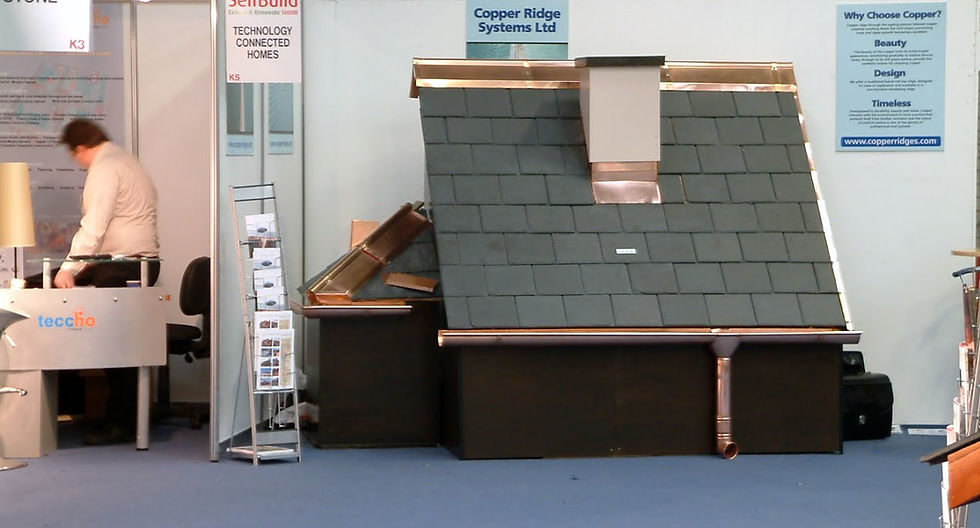
At the time, I was promoting copper roofing and handcrafted copper details for domestic properties. The display included copper ridges, valleys, flashings and rainwater systems.
This was not simply about creating an attractive roof. I was already thinking about the roof as a complete system and considering what happened to rainwater after it landed on the building.
More than two decades later, that thought process has not changed. What has changed is the growing need to take it seriously.
Why copper formed part of that early thinking
Copper offered durability, craftsmanship and the ability to create properly formed roofing details.
It also made sense when considering the future collection of rainwater. Water does not simply touch the slate or tile before reaching the gutter. It may pass through valleys, around chimneys, over flashings and through outlets.
If that water is going to be collected and reused, every material it encounters becomes part of the rainwater harvesting system.
That is why I began introducing copper valleys and other copper details into my roofing work more than 20 years ago. It was not a new marketing idea. It formed part of a much wider view of how roofs would eventually need to perform.
Rainwater harvesting from roofs
Rainwater collected from roofs can be stored for suitable non-drinking uses, including watering gardens, washing vehicles and other everyday purposes.
As periods of dry weather place greater pressure on treated water supplies, allowing clean rainwater to disappear directly into underground drainage makes less and less sense.
Solar panels demonstrated that an unused roof surface could become a source of energy. Rainwater harvesting can turn that same roof into a source of reusable water.
The roof covering, valleys, flashings, gutters and storage system must therefore be considered together.
Why roofing materials matter
Lead has performed an important role in traditional roofing for generations. It is familiar, workable and widely available.
However, I have questioned for many years whether it remains logical for rainwater intended for reuse to pass over lead when practical alternatives can be installed.
This is not simply a debate about whether a flashing keeps water out of the building. We must also consider the water travelling across it.
As rainwater harvesting becomes more common, homeowners, architects and roofing contractors will increasingly need to ask:
What materials has this water passed over before reaching the storage tank?
Why copper cannot provide every answer
Copper remains one of the finest roofing materials available. In the correct setting, its durability, appearance and ability to form precise details are difficult to match.
However, copper requires specialist fabrication skills and has become an increasingly expensive raw material. It will remain appropriate for premium, architectural and heritage work, but it is unlikely to become the mainstream replacement for every traditional lead detail.
The roofing industry needs another practical option: a material that can achieve a traditional appearance, can be worked by competent roofing contractors and does not make an ordinary domestic roof prohibitively expensive.
Where Leadax fits
This is why I support Leadax.

I have used Leadax on roofing projects for more than three years. My support is based on installing it and understanding how it performs in real roofing details.
Leadax provides a practical alternative in the space between traditional lead and specialist fabricated metals such as copper and zinc.
It can be used for valleys, chimney details, roof junctions and other applications traditionally associated with lead. Its longer lengths can reduce unnecessary joints, while its lighter weight makes it easier to handle on site.
It also retains the traditional appearance that many homeowners want, without requiring copper to be specified where its cost would place it beyond mainstream domestic use.
Leadax is manufactured using recycled PVB from safety glass, contains no heavy metals and is available in long rolls for roofing applications.


An alternative still requires craftsmanship
No roofing material compensates for poor design or careless installation.
Leadax must still be correctly supported, formed, fixed and sealed for its intended application. The benefit is that it gives a skilled roofing contractor another realistic option when lead is undesirable and fabricated copper or zinc is unnecessary or unaffordable.
Innovation should not remove craftsmanship. It should give craftspeople better materials with which to work.
The roof as infrastructure
The future roof will have several jobs:
Protect the building from the weather.
Support the generation of renewable energy.
Collect rainwater for appropriate reuse.
Control how that water travels across and leaves the roof.
Use materials selected with their wider environmental impact in mind.
This change will not happen overnight. Solar energy did not become mainstream overnight either.
But increasing pressure on water supplies will change how buildings are designed. When that happens, the roofing industry must be ready.
I was innovating then, and the idea is becoming reality
The photograph from Galway in 2004 is important because it demonstrates that this is not a conclusion I have reached recently.
I was already exploring better domestic roofing systems, copper details and the relationship between the roof and the rainwater it collects.
More than 20 years later, the argument is becoming stronger.
Solar changed the way people viewed the unused space above their homes. Rainwater harvesting will create the next change.
Rainwater will become the new solar, and our roofs must be ready for it.


Comments